The Last Form You'll Ever Build
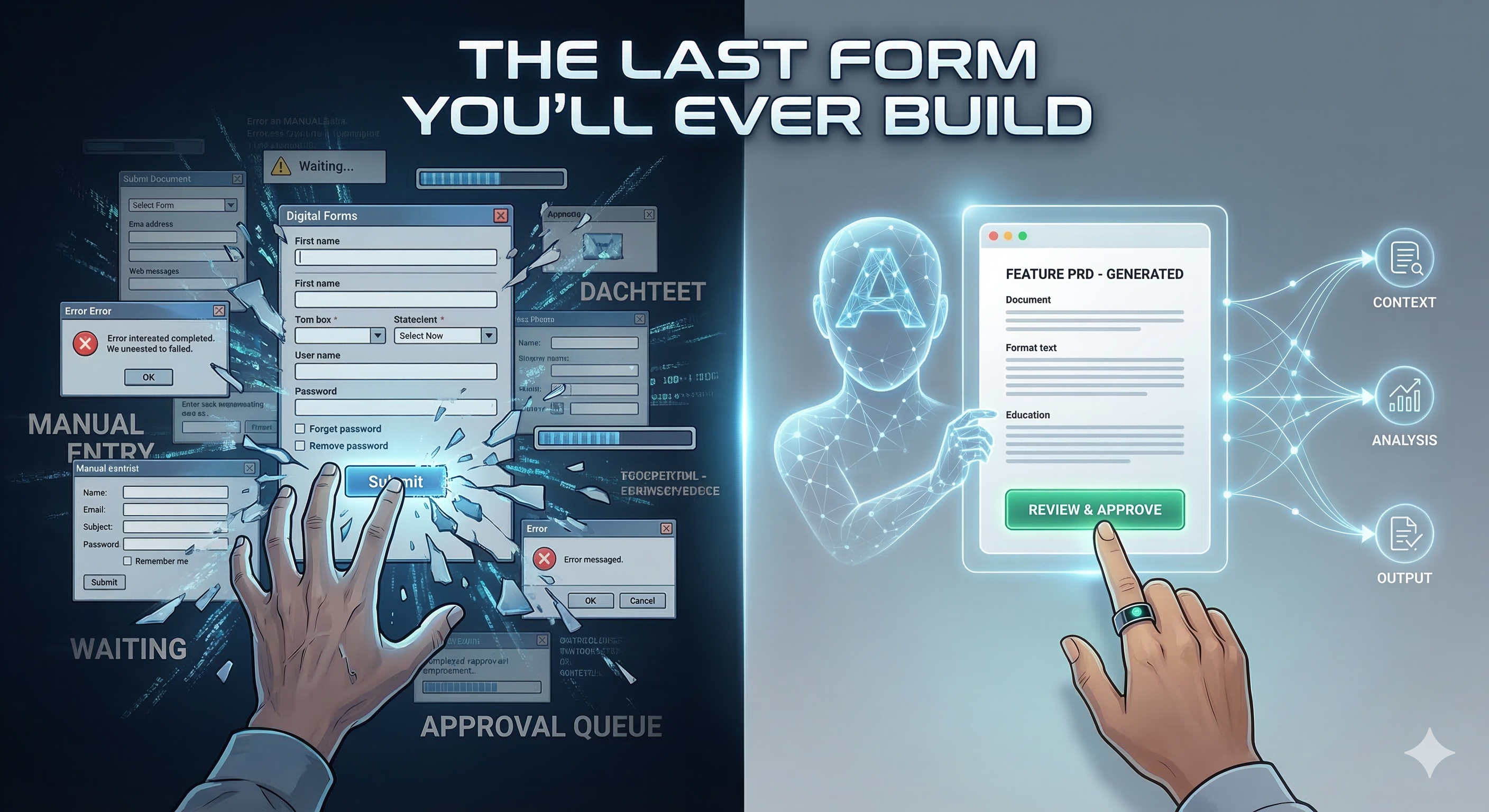
Your product team just spent six weeks redesigning a workflow. New form layouts, better validation, and smoother transitions between steps. The design system is clean. The Figma file has 47 screens. Users will save maybe 90 seconds per task.
None of it matters. The entire interaction model it’s built on is about to be irrelevant.
The traditional platform UI, the one with sequential forms, manual data entry, status dashboards, and approval queues, was designed around a specific assumption: humans are the workers, and software is the environment they work in. Every screen, every dropdown, every “Submit and Continue” button exists because a person needed to enter information, review a result, and decide what to do next.
That assumption is collapsing. And most software companies are still designing as if it’s 2019.
The Gap That Built an Industry
Every enterprise workflow ever built encodes a simple pattern: do something, wait, analyze, enter the analysis, wait, do the next thing. The gaps between steps aren’t bugs. They’re features. The entire platform exists to manage human latency.
Think about how a feature request moves through a typical software organization. Someone files a request. A product manager reads it, thinks about it for a few days, pulls up usage data, reviews the backlog, talks to customers, and eventually writes a PRD. That PRD sits in a queue until engineering picks it up. A tech lead reads the PRD, sketches an architecture, estimates complexity, and writes a technical spec. That spec goes through review cycles. Eventually, tickets get created, sprint-planned, and assigned. An engineer picks one up, reads the context, builds the thing, and submits a PR. More review, more waiting.
Every gap in that chain is a place where traditional software inserts a UI. A form to file the request. A template to write the PRD. A board to track the status. A screen to review the spec. A dashboard to monitor progress. The software industry built billion-dollar companies selling tools to manage the spaces between humans doing sequential work.
Those spaces are disappearing.
Agentic Workflows Don’t Need Your Forms
When an agent handles a workflow step, the interaction model changes fundamentally. Agents don’t need forms to collect structured input because they extract structure from unstructured context. They don’t need dashboards to present status because they push status when it’s relevant. They don’t need approval queues because the approval becomes a single, focused review of completed work rather than a multi-step data-entry exercise.
Take that same feature request pipeline. With properly architected agentic workflows, here’s what actually happens:
A feature request arrives. An agent with access to the product context, usage data, customer feedback history, current roadmap, and competitive landscape generates a first-pass PRD. Not a template with blanks to fill in. A complete document with user stories, acceptance criteria, success metrics, and technical considerations. The product manager’s job shifts from writing the PRD to reviewing and refining it. They spend their time on judgment, not data assembly. They sharpen the priorities, adjust the scope, and add the strategic context that only a human with organizational knowledge can provide.
That refined PRD gets picked up by a technical specification agent. Same pattern. The agent has the codebase context, architectural patterns, dependency map, and performance baselines. It produces a first-pass technical spec that includes an implementation approach, API contracts, a migration strategy, and a risk assessment. The tech lead reviews and refines. They catch the architectural subtleties the agent missed, adjust the approach based on team capacity and upcoming dependencies, and flag the risks that require human judgment.
Then the implementation agents pick it up. They scaffold the feature, write tests, handle boilerplate, and follow established patterns. The engineer comes back into the picture at the PR. They review and refine. They catch the edge cases, verify the business logic, and ensure the implementation actually solves the problem.
Notice the pattern. At every stage, the human role shifts from creator to reviewer. From data entry to judgment. From “fill out this form” to “does this look right, and what did it miss?”
The UI that supported the old workflow, the forms, the templates, the kanban boards, and the approval chains, doesn’t have a role anymore. Not because the workflow is gone, but because the workflow no longer needs a human-operated interface at every step.
Human in the Loop Is an Architecture Decision, Not a Default
Here’s where most organizations will get this wrong. They’ll hear “agentic workflows” and do one of two things: either remove humans from the loop entirely and ship garbage at scale, or insert human checkpoints at every step out of habit, recreating all the latency they just eliminated.
The right answer is neither. Human-in-the-loop placement is an architecture decision, and it needs to be as deliberate as any other system design choice.
The question at every stage is: does this step require judgment only a human can provide, or is it a checkpoint that exists because humans used to do the work?
PRD generation? The agent can assemble the data, synthesize the context, and draft the document. The human review is essential because prioritization, strategic alignment, and scope decisions require organizational context and business judgment that agents don’t have. That’s a real checkpoint.
Technical specification? Same reasoning. The agent can map the codebase and propose an approach. The human review catches architectural decisions that depend on team dynamics, upcoming migrations, or institutional knowledge about why something was built a certain way. Real checkpoint.
Implementation? The agent can scaffold code that follows established patterns. The human review at the PR catches business logic errors, identifies maintainability concerns, and ensures the implementation matches the intent. Real checkpoint.
But what about the status updates between those stages? The form to file the initial request? The approval workflow to move from PRD to spec? The ticket creation and sprint planning ceremony? Those are artifacts of the old model. They exist because humans needed structure to manage handoffs. Agents don’t.
Every human checkpoint you preserve that doesn’t require genuine judgment is latency you’re choosing to keep. And in a world where your competitors are removing that latency, the cost of unnecessary checkpoints isn’t just time. It’s a competitive position.
This Isn’t Just Engineering
The SDLC is the clearest example because it’s where most teams are feeling the shift first, but the pattern applies everywhere.
Finance close processes are built around sequential human steps with forms, approvals, and review screens at each stage. An agent with access to the GL, subledger data, and reconciliation rules can produce a first-pass reconciliation. The controller reviews and refines. The eight-screen workflow that supported manual data entry and cross-referencing is consolidated into a single review interface.
Customer onboarding in enterprise SaaS typically involves a project manager creating implementation plans, configuring systems via admin UIs, updating status in a PSA tool, and sending templated emails. An agent with the customer’s contract data, technical requirements, and implementation playbook can generate the onboarding plan, configure the initial setup, and draft the communications. The CSM reviews and refines. The 15-tab admin console and the project management board become artifacts.
Deal review in a PE context follows the same shape. An analyst manually assembles a CIM summary, pulls comps, builds a preliminary model, and writes an investment memo. An agent with the right context can produce the first pass of all of it. The deal team reviews and refines, applying the pattern recognition and relationship context that agents can’t replicate.
In every case, the traditional platform UI was built to support humans doing sequential data work. When agents handle the data work, the UI that supports it becomes overhead.
What Replaces the Platform
If forms and sequential workflows are dying, what takes their place?
The interface shifts from “an environment where humans do work” to “a surface where humans exercise judgment.” That’s a fundamentally different design problem.
The new UI is a review interface. It presents completed work for human evaluation. It highlights the decisions that need human input and hides the mechanical steps that don’t. It surfaces confidence levels so humans know where to focus attention. It provides the context needed to make a judgment call without requiring the human to look it up.
Think of it as the diff view replacing the editor. In the old model, you opened a blank document and built something. In the new model, you review a completed draft and improve it. The interface that supports creation, with its templates, form fields, and step-by-step wizards, is different from the interface that supports review, with its comparison views, annotation tools, and approval workflows.
And here’s the part that should worry platform companies the most: the review surface doesn’t have to be a platform at all. It can be wherever the human already is. An agent can deliver a completed financial reconciliation as an Excel file attached to an email. It can post a draft PRD summary in a Slack channel for the product manager to review between meetings. It can push a formatted report directly into the tool the executive already has open. The “in the flow of work” promise that every enterprise software company has been making for a decade is suddenly trivial to deliver, because the agent doesn’t care where it puts the output. It goes where the reviewer is, not where the platform lives. The implication is brutal: if the output can meet the human in their inbox, their spreadsheet, or their messaging tool, the platform that used to sit in between has to justify why anyone should log into it at all.
Most product teams haven’t made this shift yet. They’re still building creation interfaces for workflows that are becoming review interfaces. They’re adding AI “assistants” that help users fill out forms faster, even though the forms themselves are about to become unnecessary.
The Uncomfortable Implication for Software Companies
If you sell workflow software, the platform on which your revenue depends was designed to manage human-speed, human-operated processes. Every seat license, every “power user” tier, every workflow automation feature assumes humans are interacting with your UI to get work done.
When agents handle the work, and humans only review the output, the surface area of your product that users actually touch shrinks dramatically. A platform that used to require 200 active users navigating 50 screens might now require only 20 reviewers using 5 screens. Your per-seat model just lost 90% of its addressable surface.
This isn’t theoretical. Every SaaS company in the B2B space needs to be thinking about what their product looks like when the primary user is an agent and the secondary user is a human reviewer. The companies that figure this out will build the next generation of workflow platforms. The ones that keep optimizing their form builders will be selling typewriters in 2028.
What This Means For You
If you’re building software, stop investing in creating UIs for workflows that agents will handle end to end. Start investing in review interfaces that let humans exercise judgment efficiently. The highest-value design work right now isn’t making forms prettier. It’s figuring out what the review experience looks like when an agent has done the first 80%.
If you’re running engineering or product teams, map your current workflows and identify every step where a human is doing data assembly rather than exercising judgment. Those are the steps agents will absorb first. Design your agentic architecture with human checkpoints only where judgment is genuinely required, and be ruthless about cutting the ones that exist out of habit.
If you’re evaluating software for your organization, ask vendors a new question: “What does your product look like when agents are doing the work, and humans are reviewing the output?” If the answer involves the same UI with an AI chatbot bolted onto the sidebar, they haven’t thought about it yet.
The form-based, sequential, human-operated workflow lasted 50 years. It was a good model for a world where humans were the workers and software was the tool. That world is ending faster than most people realize.
The next interface isn’t a better form. It’s no form at all.